Back in February 2020, I did 100 push-ups every day for 30 days. Being a software engineer myself, I wanted to approach this challenge as an experiment.
I did not get to write about my experience until now, so here we are. I will present the data first, then interpret the results.
Prelude
After years of a sedentary lifestyle, I started exercising in May 2017. During the first few months, I ran regularly, 3-4 times a week. Then in December 2017, I started working out as well.
When conducting this experiment, I was already in good shape after 2.5 years of consistent exercise.

Experiment setup
I split 100 push-ups into multiple sets. Between each set, I rested for 2 minutes.
Within each set, I did as many push-ups as I could until failure. In the last set where I reached 100, I did not stop and still continued until failure. Because of that, I usually did 3 or 4 more than 100 push-ups daily.
Here is a sample day:
- Set 1: 30 push-ups
- 2 min rest
- Set 2: 22 push-ups
- 2 min rest
- Set 3: 16 push-ups
- 2 min rest
- Set 4: 12 push-ups
- 2 min rest
- Set 5: 11 push-ups
- 2 min rest
- Set 6: 10 push-ups
Total: 101 push-ups
Success metric
A good experiment needs a well-defined success metric. I chose max reps per set as my measure of success.
I always did the max number of push-ups in the first set each day and noted that number daily.
Hypothesis
My hypothesis was simple: if I did 100 push-ups every day, I would increase the max number of push-ups I could do in a single set over time.
Ideally, the increase should be linear and I should be able to do more reps every one or two days.
Das experiment
I love charts, and this article would be incomplete without one. The chart below shows the max number of push-ups I did in a single set from day 1 to day 30.
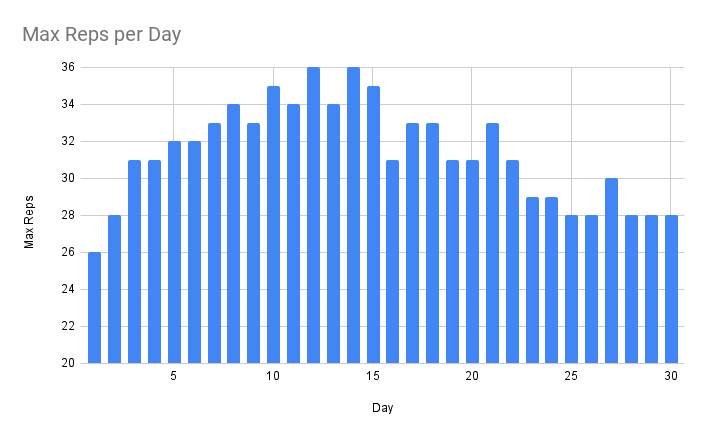
On the very first day of the experiment, I was able to do only 26 push-ups in the first set. However, there was almost linear growth during the first couple of days and I was able to do 36 push-ups on day 12, 10 more compared to day 1.
That was incredible. I estimated that I might even reach 50 push-ups, or at least 45, on day 30.
That is not exactly what happened afterwards.
After day 14, my reps plunged and I ended up with 28 push-ups on day 30: just 2 more than day 1 and exactly the same as day 2.
Analysis
In my humble opinion, this experiment demonstrates the importance of recovery.
I trained the same muscle group every day. Without rest days between workouts, my body was not able to recover, and I completely erased my gains starting from day 14.
What about age?
At the time of the experiment, I was in my late thirties. A 20-year-old might need less recovery time, so the results might differ. If you are younger, I still recommend trying this experiment yourself and comparing your data.
Next steps
I am planning to run a push/pull challenge soon: 100 push-ups one day and 20 pull-ups the next day.
That means 15 days of push-ups and 15 days of pull-ups in 30 days. Since each workout will train different muscle groups, I hope I will get enough recovery this time and increase max reps per set linearly.